
Uniform Corrosion
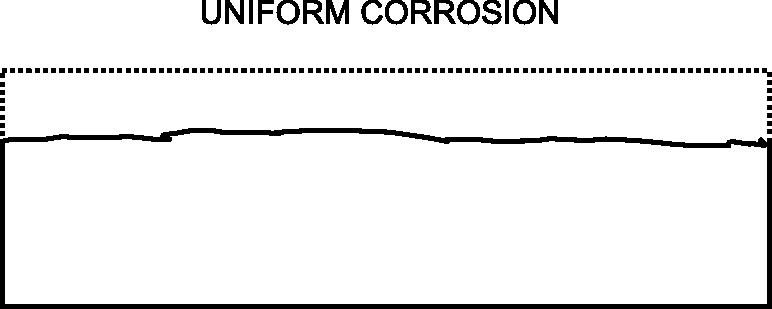
Uniform corrosion shows as nearly even erosion of material over the entire surface. It occurs due to continually changing local anode and cathode regions on the surface when in contact with an electrolyte, such as seawater.
Steel hulls typically include a design allowance for uniform corrosion, which results in thicker hull plates.
Galvanic Corrosion
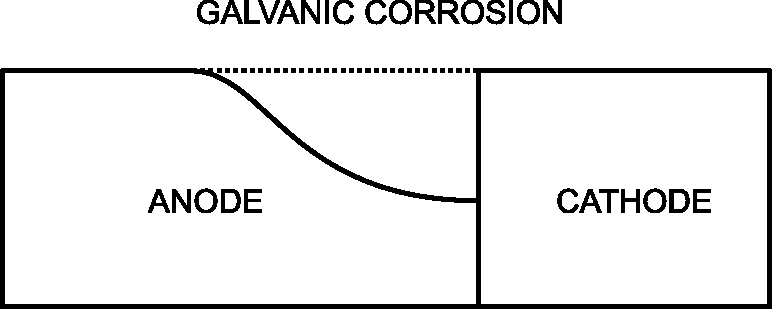
Galvanic corrosion occurs when two metals with different electrical potential are connected in an electrolyte. The metal with lower (more negative) electrical potential becomes the anode and starts to corrode.
An example of galvanic corrosion is a stainless steel bolt that is installed in an aluminium stern drive unit. To minimize harm caused by galvanic corrosion, these design considerations should be taken into account:
- Electrically insulate the bolt from the stern drive. Note, however, that insulation can fail during installation or over the years. For this reason, it needs to be verifiable and monitored.
- Install and connect the parts to a third metal part with lower electrical potential. This part is commonly known as a sacrificial anode, as it will corrode on behalf of the bolt and stern drive.
- Use protective coatings on the metal surfaces. For example, the stern drive can be treated with corrosion-resistant conversion coating and powder coating.
- Use metals with similar electrical potentials.
- Design so that the anode-to-cathode area ratio is high.
- Include design allowances to account for the corrosion.
- Locate and install the sacrificial anode so that it is easy to inspect and replace.
Crevice Corrosion
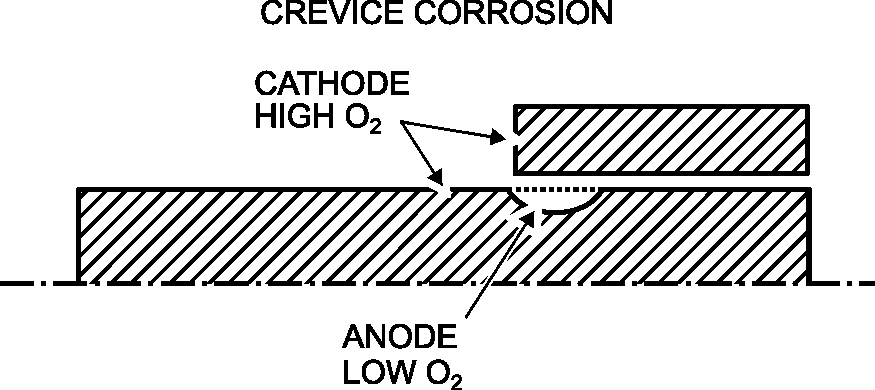
Crevice corrosion occurs when two metal surfaces overlap in a corrosive environment. This is known as a concentration cell. Two common cases of concentration cells include oxygen cells and metal-ion cells.
An oxygen concentration cell occurs when the area where two metals overlap becomes depleted of oxygen. The area with low oxygen content becomes an anode relative to the exposed area, which has higher oxygen content. Corrosion is aggressive because the area of the anode is typically much smaller compared to the exposed area.
Metal-ion cells mainly concern copper alloys. Here, the overlap area of metals becomes the cathode and the exposed area becomes the anode. This is because the water flow removes corrosion products from the exposed area. This effect can also occur on a rotating disc in seawater. The outer radius of the disc has a higher linear velocity than the center of the disc. Thus, the corrosion products are washed away from the outer radius, making it the anode compared to the center of the disc.
Pitting Corrosion
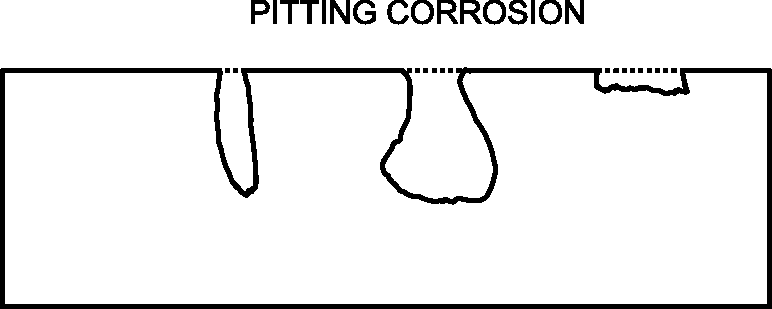
Pitting corrosion is one of the most aggressive forms of corrosion and it shows as localized holes in the metal material. It typically occurs on stainless steels and other alloys that rely on a protective oxide layer. The pit starts to form due to these common reasons:
- Chemical attack: Ferrous chloride or aerated seawater on stainless steel.
- Mechanical attack: Impact or abrasion that removes part of the protective film.
- Crevice corrosion in stagnant seawater.
Erosion-Corrosion
Erosion-corrosion occurs in areas where electrolyte flow is high, e.g., near the propulsion drive. The abrasive effect of the high-velocity flow accelerates the corrosion as it removes the protective oxide layer of the metal. Different metals tolerate high electrolyte flows differently. Copper-nickel and titanium alloys typically have a high tolerance to high flow velocities.
Dealloying
Dealloying is localized corrosion on the metal surface. It occurs due to dissimilar metals within the same alloy. For example, brass is an alloy that contains zinc and copper. When dealloying occurs, the zinc, as the less noble metal, is removed and copper remains. Dealloying of brass shows as its natural yellow color turning reddish or more coppery. A small amount of tin is added to brass to prevent dealloying.
Stress-Corrosion-Cracking
Stress-corrosion-cracking is not well understood, but it is affected by these parameters:
- Composition of the corrosive environment
- Minimum tensile stress levels
- Temperature
- Metal composition
- Metal structure
Cyclic stresses, the presence of a minimum tensile stress level, and corrosion can cause the surface of the metal to lose its protective film and cause cracks to propagate.
Intergranular Corrosion
On a microscopic level, metals contain grains of different directions that have small gaps between them called grain boundaries. Heat treatment or welding can change the grain boundary properties, leading to intergranular corrosion. This is a common problem with welding of stainless steel and can cause severe corrosion in environments where the stainless steel would not normally corrode.
Fretting
Fretting occurs on mated surfaces that are allowed to vibrate or slip against each other. Typical locations include bearings, shaft sleeves, and gears. The abrasion damages surfaces and removes the protective layer of the material.
Biological Corrosion
Biological corrosion is a significant contributor to corrosion in marine engineering systems. It can be categorized as follows:
- Microbiologically induced corrosion. It is caused by aerobic and anaerobic bacteria and other microorganisms that can accelerate corrosion. This shows as pitting-type corrosion.
- Macrofouling effects. Marine growth such as barnacles produce acidic by-products that can accelerate corrosion. They also create crevices at their attachment points that are subject to crevice corrosion.
Stray Current Corrosion
If two or more pieces of equipment with metallic structures are connected by electrical wires and are in contact with the same electrolyte (such as bilge water or seawater), they form a galvanic cell and corrosion will occur.
Depending on the electrical connections, the action of electrical currents in the wires can accelerate the corrosion significantly. This is called stray current corrosion, and it is one of the most aggressive forms of corrosion. Other possible sources of stray current come from the shore power system and welding generators.
To prevent stray current corrosion between onboard equipment, all metal surfaces that are exposed to bilge or seawater must be bonded to the negative side of the battery.
Solution to Corrosion Problems
At PerformanSea, we help our customers identify, solve, and minimize costs related to corrosion. We develop detailed technical instructions to verify and maintain the correct functioning of corrosion protection systems, and provide suggestions based on best industry practices.